Free companion guide
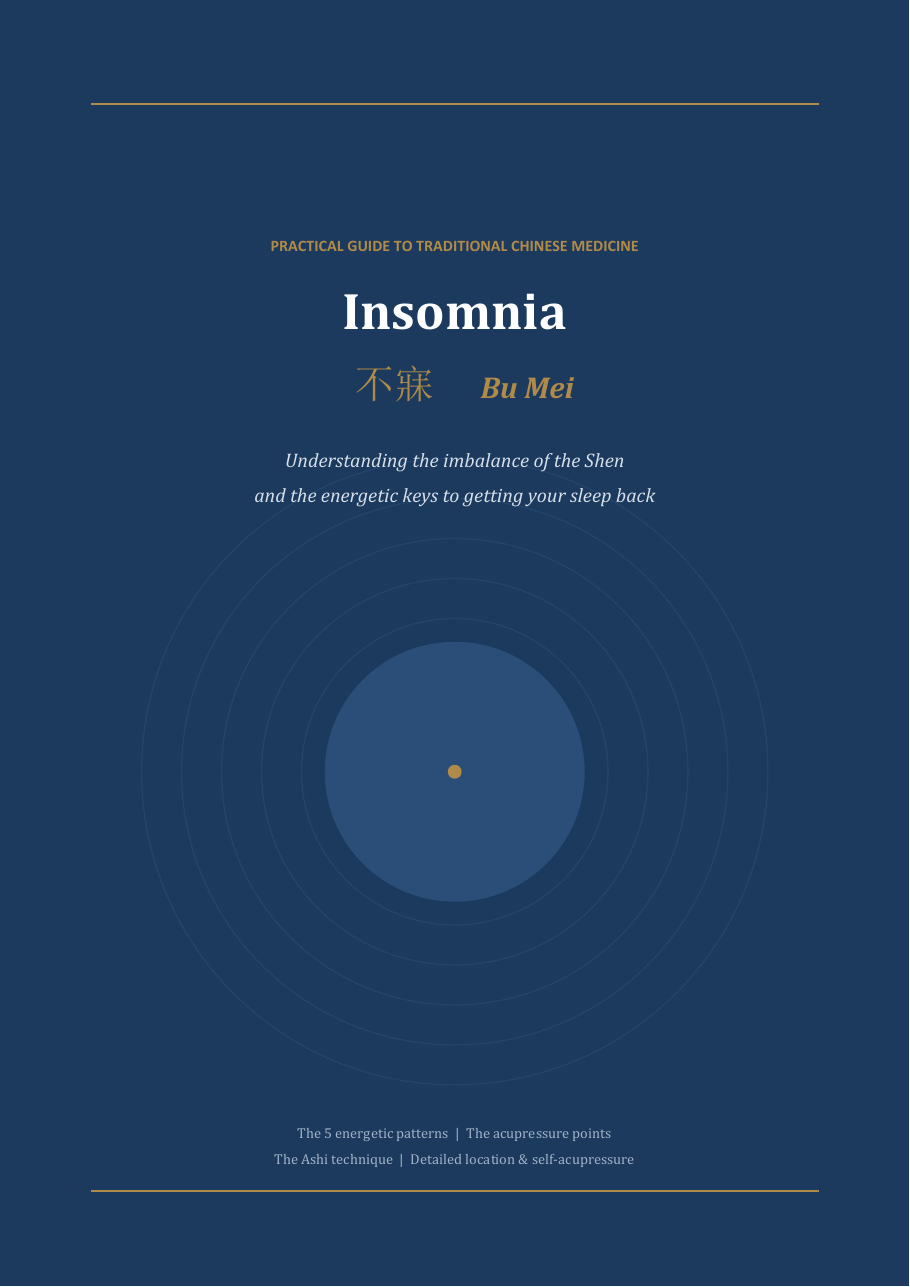
Insomnia in Traditional Chinese Medicine
不寐 · Bu Mei
Understanding the imbalance of the Shen — and the energetic keys to getting your sleep back. 13 pages, the 5 patterns, and every acupressure point explained.
No email, no sign-up. Or read it in your browser.
What’s inside
Not a list of sleep tips. The actual energetic logic behind your sleeplessness, and what to do with your own hands.
Why the Shen won’t settle
The Heart as the residence of the Spirit, and the three conditions — Yin, Blood, free flow of Qi — that have to be met before sleep can happen at all.
Excess or deficiency?
The two great mechanisms of TCM, and why two cases of insomnia that look identical call for opposite treatments: disperse, or tonify.
The 5 patterns and their points
For each syndrome: the mechanism, the signs that identify it, the treatment goal, and the exact points with their meridian and energetic action.
The 3 core points
Shenmen (HT7), Sanyinjiao (SP6) and Anmian — the points acupuncturists keep in every protocol, whatever your pattern.
The Ashi technique, in 4 steps
A point is not a fixed pixel on a chart. Learn to find yours by palpation: the bony landmark, measuring in cun with your own hand, slow pressure, and recognising the De Qi signal.
Precise location, region by region
Head and neck, back and abdomen, arms and hands, legs and feet — every point located in plain language, plus the daily self-acupressure practice.
Which of the five is yours?
The guide gives you the signs to recognise your own pattern — that is what determines your points.
- Heart and Spleen deficiency — the insomnia of the overthinker: light sleep, many dreams, waking up tired.
- Liver Fire disturbing the Heart — the insomnia of anger and repressed stress: impossible sleep onset, irritability, nightmares.
- Internal Phlegm-Heat — the insomnia of dietary excess: restless sleep, heaviness in the head, oppression in the chest.
- Kidney Yin deficiency and Empty Fire — waking at 3–5 AM with no way back to sleep, hot flashes, night sweats.
- Gallbladder Qi deficiency — the insomnia of fear: waking with a start at the slightest sound, diffuse anxiety, indecision.
Educational use. This guide presents the traditional Chinese view of sleep disorders. It is not a medical diagnosis and does not replace the advice of a healthcare professional. If your insomnia is severe, persistent, or accompanied by other symptoms, please consult a doctor. Self-acupressure is gentle and low-risk, but seek professional guidance during pregnancy or if you have a medical condition.